Water, water everywhere

While there are anomalies – like Flint, Michigan – most Americans have access to clean water. We can take it for granted that, when we turn on the tap, the water will flow. And it will be drinkable.

But access to safe water isn’t universal, and while estimates vary, there are likely well over a billion people who lack clean water.

So water purification technologies matter, and can hopefully be deployed to make clean water more widely available. Here are five of the latest ones that I found listed on Water Technology.

Nanotechnology is one promising water purification process. It has two critical benefits that put it ahead of traditional methods: it’s “considered to be highly efficient and cost effective” – definite pluses when it comes to technology!

Nanotechnology involves several approaches and processes of applying materials on the atomic or molecular scale…The large surface-to-volume ratio of nanoparticles enhances the adsorption of chemical and biological particles, while enabling the separation of contaminants at very low concentrations. Nanoadsorbents feature specific physical and chemical properties for the removal of metallic pollutants from water.

One of the most widespread nanomaterials in use is carbon nanotubes (CNTs). Filtration systems based on this technology “can remove organic, inorganic and biological compounds from water.”

Acoustic nanotube technology was developed at NASA’s Johnson Space Center in Houston. It uses acoustics rather than pressure “to direct water through small-diameter carbon nanotubes.”

The technology is based on an acoustically driven molecular screen integrated with carbon nanotubes that allow the passage of water molecules while blocking any larger molecules and contaminants. It consumes less power than traditional filtration systems and drives water away from contaminants instead of removing pollutants from water. The process also eliminates the need for flushing the filter system.

This technology is primarily used in large-scale facilities like city water and wastewater treatment plants.

Photocatalytic water purification technology uses photocatalyst and UV rays to rid toxic substances from water. We have Panasonic to thank for this highly efficient technology. This technology is well-suited for treating wastewater full of organic material and metals. Among its properties, this technology can recover the photocatalysts from the water and reuse them.

Photocatalysis can break down a range of organic materials, estrogens, pesticides, dyes, crude oil, and microbes such as viruses and chlorine-resistant pathogens, as well as inorganic compounds such as nitrous oxides.

Aquaporin Inside™ technology comes to us from Aquaporin, a Danish cleantech company. Its biomimetic membrane design lets it selectively transfer water across the cell membrane.

The aquaporin channel’s distinct architecture allows the passage of water molecules and blocks all other compounds. The natural bio-mimetic membranes also serve as a basis for the development of artificial bio-mimetic membrane systems. The technology is being used in industrial and household water filtration and purification systems.

The final technology on the list is Automatic Variable Filtration (AVF) technology. As with most of the other technologies on the list, AVF is good for municipal drinking water and wastewater treatment facilities. The approach is pretty straightforward: the “upward flow of influent is cleaned by downward flow of filter media,” removing the need for any additional processes:

The AVF method employs continuously cleaned descending bed filters embedded in a variable array. The two-stage configuration of the system integrates two sets of media filters that can function either in serial or parallel mode.

The process delivers water with quality equivalent to that of micro-filtration technology and at a fraction of the cost of low-pressure membranes. It features no moving parts and consumes less power, offerings savings on reduced operating and maintenance costs.

High quality at low-cost sounds like a winning value proposition, and I suspect the lower operating and maintenance costs would make AVF technology very attractive in less-developed regions where keeping costs low is so critical, and where there may not be a lot of technicians available to keep things up and running.

That’s it for the Water Technology list. Think I’ll go pour myself a nice, refreshing glass of Syracuse, NY tap water, straight from beautiful Skaneateles Lake. Lucky, aren’t we, to be able to take this for granted?

 

Trends in embedded development: a Critical Link perspective on a Mouser perspective

The other day, I was browsing Embedded.com and came across Trends in embedded development: a Mouser perspective by Mark Patrick, who’s a UK-based technical marketing manager for Mouser, a major distributor of semiconductors and electronic components. This is a topic of obvious interest to me, so I thought I’d share a Critical Link perspective. (I don’t know Mark, but we are partners with Mouser, which distributes some of our SOMs and Development Kits.)

The growing chip- and board-level integration trend
In the first section of his piece, Mark talks about key aspects of the growing chip- and board-level integration trend. It’s hard to argue with his opening line that “any embedded design today is significantly different from those twenty years ago.”

Think back those twenty years. Yes, the Internet, as predicted, was already starting to change everything. And, yes, the term “Internet of Things” had already been around for a while. But the IoT as we came to know it didn’t really start taking off until the mid-2000’s. Now, well, just about everything is connected (or at least could be). And users are more demanding of the interface look and feel. So I think Mark nailed it by focusing on connectivity and display requirements.

Firstly, connectivity is paramount, which adds extra functionality and emphasizes security. Also, as users, the level of interaction we expect from an embedded system is high, whether with our smart devices, in our car, or at work. No longer will a couple of LEDs suffice; some form of sleek display, no matter how small, and a functionally rich user interface, have become the norm. These two features alone – connectivity and a display – introduce many conflicting design constraints, such as minimal size and power consumption.

As well as budget and time-to-market pressures. Mark discusses a couple of ways that engineers deploy board level integration to satisfy these constraints: the use of wireless (RF) modules, wireless systems on chips (SoCs), and DC/DC converters. Another obvious answer is System on Modules (SOMs).

Connectivity and display both directly drive the need for a microprocessor (as opposed to a microcontroller). And this drives the need to design a dense SoC device with difficult escape routing and DDR. DDR is both a routing and a signal integrity challenge, which can put working with it above the skill level of an engineer who has only designed with microprocessors in the past. A good answer: design with a SOM!

Connectivity and display requirements can drive the need for a higher-level operating system, like Embedded Linux, which may also be new ground for an embedded engineer.

What to look out for when it comes to connected devices
When it comes to connectivity, Mark’s focus is on wireless.

From a user’s perspective, we take connectivity for granted and expect it to work reliably. For the engineering team, however, provisioning wireless connectivity opens a checklist of requirements. Questions include the range, how much data, how frequently, interoperability, and how the application will be powered. In turn, this helps guide the choice of wireless protocol and topology.

There is a lot to selecting a technology to use for a wireless solution, and matching requirements to different protocols can be a challenge. Accessing experience in these areas is definitely helpful. This is where s can help a lot.

Another key consideration when developing wireless is FCC certification. If you’re doing your own ground-up design, this is an expensive and time-consuming endeavor. Wireless modules come with this certification which can be a big time and money saver for designers.

It’s a big open field that engineers can choose from for the technologies they’re going to use. As Mark notes, engineers will tend to go with what they know and what’s comfortable for them. We see this with repeat designs for customers using our SOM modules. Not only do they get to know how to use our module, but they get to know us and how we support them through the process.

How virtual working will impact the future of embedded development
In the final section of his article, Mark notes that embedded development lends itself well to collaborative (virtual) work, and offers a roundup of the tools available to those working virtually: GitHub, PlatformIO, Microchip’s MP Lab X, Arduino’s ‘Arduino Editor,’ Edge Impulse, “’low code’ pseudo languages such as Node-RED that supplement traditional embedded development languages like C,” and MikroE’s Planet Debug service.

The issue I see is not any lack of development tools for remote, virtual working. Many of them have been around for a while. I see the issue being more one of “is everyone on the same page”, with the same understanding of the requirements. Are the requirements even well fleshed out? This is much more about team communication and remote teamwork, which is being tackled across all industries and functional areas – not just embedded development.


A bit of Silicon Valley history

In late 1971, Intel brought out the first microprocessor. A few months later, EE Times – long a go-to for news and insights on the semi-conductor world, embedded systems, AI, and other trends – brought out its first issue. While semi-conductor history goes back a lot further than fifty years, it was the microprocessor that ignited the process that took computing from the realm of the mainframes; to personal computing using workstations, desktops, and laptops; to today’s era of ubiquitous computing on all sorts of devices.

EE Times is kicking off its Golden Anniversary celebration with a series by Malcolm Penn on the roots of the industry, focusing on Silicon Valley where so many things began. Penn takes us back to the 1930’s when, among other key events, Bill Hewlett and David Packard, young engineers with EE degrees from Stanford, famously formed Hewlett-Packard in a Palo Alto garage. Some consider that garage the birthplace of Silicon Valley. But Penn – and IEEE – credit the Mountain View address of Shockley Semiconductors, which was established in 1956.

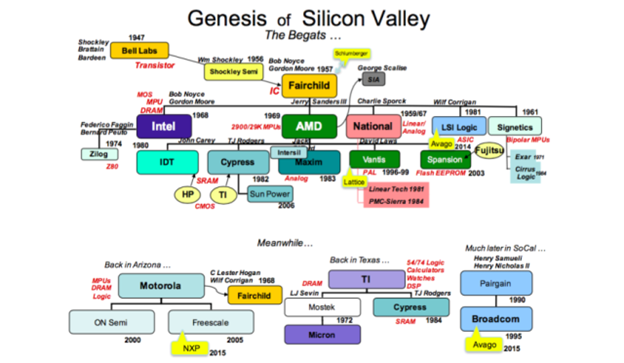
Key players in the creation of Silicon Valley’s semiconductor ecosystem. (Source: Dr. Jeff Software)

That same year, founder William Shockley, with his colleagues John Bardeen and Walter Houser Brattain, was awarded the Nobel Prize in Physics for their invention of the transistor. That invention occurred in 1947, so the transistor is, like the microprocessor, observing a major anniversary this year, too.

Gordon Moore, of Moore’s Law and Intel fame, was one of the first employees of Shockley Semiconductors.

Unfortunately, Shockley was very difficult as a manager and by 1957, employees were bailing out on him. The core engineering staff, including Moore, that Shockley had recruited – later dubbed “the traitorous eight” – got backing from Fairchild and went off to found Fairchild Semiconductors.

It quickly grew to be among the top semiconductor industry leaders, spurred on by the successful development of the silicon planar transistor.

Transistors, however, were already presenting a new challenge, dubbed the “tyranny of numbers”. If you wanted to make a simple flip-flop, it needed four transistors. About 10 wires were needed to connect them. Interconnecting two flip-flops required not only twice the number of transistors and wires but also four or five additional wires to connect the two devices. So, four transistors needed 10 wires, eight needed 25, 16 needed 60 to 70 wires. In other words, as the transistor count increased linearly, the number of connections grew exponentially, where the exponential was greater than one but less than two.

While transistors were relatively easy to mass produce, connections were much more difficult since wires had to be soldered together by hand and took up a lot of space. The industry’s desire to build bigger and more complex systems was stymied by the difficulty in wiring everything together. To this point, few had paid much attention to wiring, but connections would soon become a potential show-stopper, driving the need for the integrated circuit. (Source: EE Times – Roots of Silicon Valley, Part 2)

The solution was planar technology, which “protect[ed] the transistor surface with a passivation, or protection, layer of silicon dioxide (SiO2), grown or deposited on top of the structure.” This created a flat surface that enabled enhanced automation of the production process.

Penn deems planar technology “the second most important invention in the history of microelectronics — after the invention of the transistor — laying the foundation for future integrated circuits.”

There’s more to the story. There always is. This time, the story takes us out of Silicon Valley and deep into the heart of Texas, where Texas Instruments, which had been working in the same arena, disputed the patent claims of Fairchild engineers. (Both organizations ended up with valid patents.)

Even with the breakthrough that planar technology provided, there was still an issue that was keeping IC’s from becoming commercially viable: preventing adjacent transistors from interfering with each other. Fairchild solved his problem, and in 1960 “the first working device was produced.”

Then, in March 1961, “Fairchild announced the world’s first standard logic family of ICs, direct-coupled transistor logic.” The industry started to take off, with Signetics and TI competing with Fairchild, leapfrogging each other with new and improved editions.

Just as core engineers abandoned Shockley, core engineers began defecting from Fairchild. These engineers:

…eventually known as “Fairchildren,” directly or indirectly creating dozens of corporations, including Intel and AMD. In doing so, Fairchild sowed the seeds of innovation across multiple companies in the region that would eventually become known as Silicon Valley. (Source: EE Times – Roots of Silicon Valley, Part 3)

Despite the defections, Fairchild didn’t go anywhere, and Penn goes on to talk about Fairchild, TI, and emerging companies – AMD, Intel, National Semiconductor, et al. – and the roles they all played. Lots of interesting detail in there, but Penn doesn’t get into Intel and the microprocessor breakthrough. Hopefully, there’ll be more to come in this series on where and how it all began.

——————————-

This is a link to the first article in the series, which was not directly cited in this post.

RFusion: the robot that locates AND retrieves your lost items

When my Italian grandmother couldn’t find something, she always said a prayer to St. Anthony, the patron saint of lost objects. “Dear St. Anthony, please look around. Something’s lost and can’t be found.” Only she said it in Italian. People still pray to St. Anthony, but now, of course, there’s technology to help us locate something we’ve misplaced.

(Have you ever been in a parking lot or garage and pressed the button on your key fob to see if you could figure out where your car was? Thought so! And if you can’t find your car keys, there are any number of key finders on the market that let you track down your keys using your phone. What if you’ve misplaced your phone? There’s tracking technology for that, too.)

Now, thanks to researchers at MIT, there’s a robot that will not just locate your lost whatever, but will fetch it for you – even when your lost whatever is out of sight: stuck between the couch cushions, in a stack of papers on your desk, in that pile of clothes that have been piling up on the chair in the bedroom.

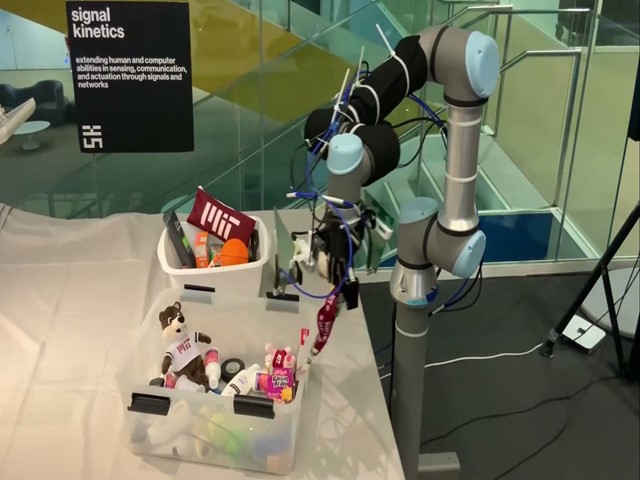
RFusion, is a robotic arm with a camera and radio frequency (RF) antenna attached to its gripper. It fuses signals from the antenna with visual input from the camera to locate and retrieve an item, even if the item is buried under a pile and completely out of view. The RFusion prototype the researchers developed relies on RFID tags, which are cheap, battery-less tags that can be stuck to an item and reflect signals sent by an antenna. Because RF signals can travel through most surfaces (like the mound of dirty laundry that may be obscuring the keys), RFusion is able to locate a tagged item within a pile. Using machine learning, the robotic arm automatically zeroes-in on the object’s exact location, moves the items on top of it, grasps the object, and verifies that it picked up the right thing. The camera, antenna, robotic arm, and AI are fully integrated, so RFusion can work in any environment without requiring a special set up. (Source: MIT News)

How does RFusion work?

How does RFusion work?

First off, you have to attach an RFID to the items of interest. The robot then pings the RFID using an antenna. It then uses positioning technology to calculate the distance to the tag. There’s then a 3-step process in which RFusion combines the RF with visual info to pin down the location and retrieve the item.

The first step deploys Dense RF-Visual Geometric Fusion:

Given the round-trip distance to the RFID, the robot maps that distance to a spherical ring centered around the wrist-mounted antenna. Subsequently, it geometrically intersects this spherical ring with the RGB-D data obtained from the wrist-mounted camera, resulting in a list of candidate locations. (Source: MIT Media)

Next up, RF-Visual Reinforcement Learning. The robot then collects additional RF and visual measurements, and with an AI learning network starts homing in on the exact location of the target item. RF-Visual Grasping is the final step.

So far, the retrieval success rate for “fully occluded objects” is very high: 96%.

One of the researchers, MIT’s Fadel Adib says that you can think of it as “a Roomba on steroids.” (I think of it more like a really smart version of those claw machines they have in arcades, supermarkets, and bowling alleys. The ones your kids pester you to use, thinking that they’ll actually be able to claw a toy out of.)

The MIT researchers are looking beyond the “Roomba on steroids” (or claw machine) stage. While finding and fetching lost keys is certainly useful, the researchers envision many applications in manufacturing and warehousing, as well as in providing assistance to the elderly and disabled.

Definitely interesting technology that’s worth keeping an eye on. Meanwhile, prayers to St. Anthony can’t hurt.

What you missed if you missed CES 2022

When you’ve been blogging as long as we have – and we’re coming up on nine years now – you tend to develop a few traditions. One of ours is doing holiday tech toy shopping for kids and grownups. Another is paying a virtual visit to CES, the mega consumer electronics show held each year in Las Vegas. Admittedly, consumer electronics is not exactly the bullseye for Critical Link. We’re more on the “industrial strength” end of the application spectrum. Still, we’re also consumers (not to mention engineers), so we’re always interested in what’s happening in the consumer space, too.

So what was there to see at CES 2022? For starters, I’m going to rely on Greg Kumparak’s roundup article, which appeared a couple of weeks ago in Tech Crunch.

As a car guy, I was naturally intrigued by the first item he mentioned: BMW’s color-changing car, which uses E Ink technology to change things up. We can’t get too excited as yet. It’s only a demo, and it only let’s you choose black, white, or shades of gray. But one can easily imagine the future, where people can change the color of their car to match their mood – or the color-scheme for a wedding party. (Limo companies will, I’m sure, jump right onto this.) More practically, a car owner might switch from black to white on a hot sunny day, keeping the car cooler and saving on energy costs. All very interesting, but I can’t help thinking about what it will do to descriptions of getaway cars. And will this technology let the bad guys temporarily paint their vehicles to look like police cars while they do their criming. Just where my mind goes. But the technology is certainly interesting.

Bob the countertop dishwasher doesn’t need to be plumbed. If you’re living in a small space, and aren’t doing dishes in family mode, Bob, from Daan Tech, uses just one gallon of water to wash a (small) load, which the company estimates is about one-fifth the amount used for hand-washing. Better yet, Bob comes equipped with a water-free setting that uses UV-C to disinfect items, like your phone, that you can’t put through the washer. Bob is already on the market in Europe, where it’s done pretty well. And will be available in the States later this year.

If you know anyone with diabetes, you’re familiar with the need to do glucose monitoring, which means endless finger pricks to take blood samples to test. Scanbo is an AI company that’s prototyped a non-invasive device for monitoring blood glucose levels. The device uses electrodes to capture cardio data, and optical tech to detect blood volume changes. It then uses special algorithms to analyze the glucose level. They’re starting the process of gaining FDA approval. Sounds very promising. And good news for those who’ve been stuck with finger sticks.

Solar shingles have been around for a while but have required specialized installation processes. Timberline Solar from GAF Energy is designed to be installed by the average roofer with the average nail gun. By bringing down complexity and costs, it’s hoped that more people will adopt energy efficient roofing. (UL has a new “building-integrated photovoltaic (BIPV) solar roofing certification) and GAF Energy is the first company to receive the certification.)

What are some of the trends spotted at CES 2022? Smart homes are getting smarter, and some of the biggest players – Apple, Amazon, Google – “have banded together to build a [smart home device] protocol called Matter.” Robots are getting more lifelike and/or more useful. EV charging is getting a lot of attention, which will translate into EV’s becoming more universal. Lots of talk about the metaverse (which I’m choosing to ignore for now). And, since it wouldn’t be CES without them, lots of fun gadgets.

Hopping over to The Verge now to see which products got their best in show awards, they gave their “Best in Show” nod to the Samsung Odyssey Ark, a 55-inch curved, wrap-around computer monitor/screen with 4K resolution. No price available as of yet, but I’m guessing that, if you need to ask the price, it’s probably more than you’re willing to pay! A few other “bests” also caught my eye. They gave their “Best Concept” award to that E Ink car paint. For the “Best Robot,” The Verge liked a robot shelf dubbed the Labrador Retriever, which looks nothing like a Lab, but unlike your average Lab, it can maneuver its way to your fridge, open the door, and grab something out of it for you, which will prove very useful to those with limited mobility (or who are just plain lazy).

That’s it for CES 2022. Maybe I’ll get there in person next year…


Tech predictions for 2022

As a new year begins, I’m always interested in seeing what the prognosticators are prognosticating will happen over the next twelve months. So I was more than happy to wander around seeing what different sites had to say about what they’re foreseeing for 2022.

First up is Alex Pasternack’s piece from Fast Company, a roundup of predictions they gathered from tech folks, investors, and pundits.

At the macro level, these experts are betting on some of the usual suspects – some that have been on the trending lists for a while, some that are more recent comers: more autonomous vehicles, more widespread deployment of AI (think low-code and no-code frameworks), more AR glasses in use, more regulation for Big Tech – especially around antitrust and privacy, more quantum computing; Web 3; crypto; bioengineering; digital health. Then there are the new suspects like the metaverse.

Among the observations I found most interesting was the prediction that enterprise blockchain and Web3 will take off, which will start to put an end to the stranglehold that the social media giants – I don’t need to name any names – have on user data.

Then there’s all the talk about the metaverse which, I must admit, even as an avowed techie hurts my head. The metaverse is an extreme reflection of the fact that more and more of our lives are conducted online, in the case of the metaverse in a virtual-reality environment where avatars abound and where NFT (non-fungible tokens) replace ownership of physical assets. Maybe I’m turning into an old fogey, but at the end of the day, I like having an actual yard where my flesh-and-blood dogs can run around, even if I have to actually get out there and actually mow it.

Overall, the Fast Company article is a good read, albeit a long one. I will note that it ends on a pretty weird note, with talk of things called “religiously skinned tokenization” and “divinatory platformization.” Now, I consider myself as bright as the next guy, but…

Over on Newstack, Richard MacManus looks out from a developer’s perspective. Like others, he’s looking at Web3/crypto and forecasting a market correction. His reasoning? “Nothing useful has been built using crypto and blockchains, other than tools for speculation like crypto exchanges and the NFT marketplaces.” I think I’m with Richard.

Among other things, he also predicts that Apple will be forced to open things up to external browsers that are currently banned (or largely hobbled) on their mobile devices. And he sees a growth in the emergence of serverless functions in the development mainstream.

His final prediction, alas, turns out to be a fake one: that a new metaverse social network will topple Meta (the company formerly known, if not exactly loved, as Facebook).

If you’re a fan of candor, then you’ll like Lance Ulanoff’s predictions on Tech Radar. He even titles his article, “Wild tech predictions for 2022 that probably won’t happen.”

Like all the other forecasters, he sees people spending more and more time in the metaverse, doing things like driving their virtual cars to the virtual homes of virtual friends, wearing virtual clothing, and “cook[ing] metaverse animals with digital spices” – which doesn’t sound very appealing to me. People will begin suffering from something he calls “meta-aversion.” Which for me has already set in.

Lance also predicts more regulation of social media firms in terms of not letting them continue to get away with “responsibility for the content on their platforms.” Then he flips to something a bit more whimsical and opines that the first private person to do a spacewalk will be Elon Musk. He then makes predictions in a number of other arenas, predictions that are either humorous or a bit frightening (just a bit!), depending on how you look at them.

Me? I’m not making any predictions of my own, other than my evergreen forecast that, while technology can be a mixed bag (c.f., NFT’s), on balance it will continue to do many, many things that help us lead healthier, happier, and more productive lives.

Happy New Year! Here’s hoping 2022 is a good one.

The top emerging technologies of the past decade – Part Two

In my last post, I covered the first four items on the World Economics Forum’s list of major technological trends of the past decade – technologies that have “changed the world.” Here I’ll summarize the other trends that made their cut.

If you’re wondering just how we’re going to replace petrochemicals, think Systems Metabolic Engineering (SysME), a “more sustainable approach to producing chemicals needed for fuels and medicine.”

Microorganisms, including bacteria, are genetically engineered to overproduce chemicals like ethanol as part of their metabolic process as they ferment, ‘feeding on’ renewable organic resources, in a safe, sealed environment. (Source: World Economics Forum)

Fuels – jet fuel, diesel, gasoline – are among the chemically-based products that this approach will help replace. Because of the environmental impact made by the use of fossil fuels, this is an especially key area for SysME. But it’s also being deployed in the medical realm, where drugs that are now produced by extracting matter from plants, insects, or animals – an expensive and time-consuming process – will now be created by fermenting “metabolically engineered microbes.”

Genome sequencing, genetic engineering, and metabolic flux analysis have all made significant advances in SysME possible.

So far, this type of chemical production hasn’t yet achieved scale economies, but look for it to become a pretty potent disruptor, where “a lot of chemicals and fuels…will be produced by biological means. Looks like chemistry majors will need to minor in biology, and vice versa.

Another top technology listed is Body Adapted Wearable Electronics. While most of us have not as yet used products created via SysME (at least not as far as we’re aware), most of us do have experience with smartwatches and health trackers. While many of us use them to be more mindful of our fitness – if you’ve ever had a Fitbit, you’ve probably found yourself pacing around the bedroom to get in your final 1,000 steps of the day – wearable electronics are also used for serious health purposes. All made possible, in large part, to the availability of flexible electronics that can be integrated into small form factors and, increasingly, apparel itself, rather than an external device.

It’s predicted that, at some point, electronics embedded in our clothing will replace our separate devices. I don’t see this happening all that soon. After all, you can wear your smartwatch as an accessory whether you’re at home, at work, hanging out in your backyard, attending a dressy event. Unless the future means we all wear something that looks like the uniform of the crew of the Starship Enterprise, I don’t see that we’ll have electronics in all of our outfits.

Personalized Medicine holds a lot of promise. Today, most patients with the same illness are treated with the same approach, which will work for some but not for others. If you think of cancers, where the results for many types haven’t really improved much over the years, many of them are a “cancer of one,” unique in its behavior depending on the composition of your DNA, your ethnic background, where you grew up, where you live now, what you’ve eaten throughout your life, what environmental factors you’ve been exposed to. Doctors are already varying cancer treatments based on what genetic markers someone has, and the direction is that medicine will get more and more personal over time.

In another instance of technology having a major impact on the health front, we have only to look at the Genomic Vaccines (“made from DNA or RNA that encode desired proteins”) that are helping fight the covid-19 pandemic. The World Economics Forum was quite prescient in putting it on their list of emerging technologies in 2017.

…and three years later, Pfizer-BioNTech and Moderna created the world’s first mRNA vaccines to tackle the world’s biggest health threat.

And they’ll be doing it again when the next pandemic pathogen comes along, which hopefully will not be any time soon.

I’ve been interested in robotics since I was an undergrad, so I am, of course, intrigued by Social Robots, if not exactly welcoming the day when they’re “looking after the elderly and educating children.” One thing to have a Roomba scooting around your living room picking up dust bunnies. Another thing to use robots to replace social interaction. Still, it’s been demonstrated that robotic pets, e.g., help the isolated elderly feel more engaged and less lonely, even when they’re fully aware that the robotic pet isn’t real. So there is a lot of potential for good. We just need to be ultra-careful about the ethical implications here.

As I wrote last time – and many other times – being an engineer has always made me proud, especially when I think about the profound impact our profession has always had on improving people’s lives. So, Happy New Year to all the engineers out there. Here’s to us!

The top emerging technologies of the past decade – Part One

It’s that time of year when many of us take a look back on what’s happened in our lives, in society, and – in my case – in technology during the past twelve months. I was taking just such a look when I came across a piece from the World Economics Forum that went back an entire decade. In Emerging technologies: 10 years of top tech trends and how they’ve changed the world, the authors focus on “significant technological advances over the past decade [that] have changed the way we live, work and interact with each other.” As an engineer, I’m always proud of what our profession contributes to the betterment of humankind, and the small role I play here, so I was immediately drawn right in. Because there’s a lot of ground to cover, I’ve split the technologies into two parts. Here goes one through four. (We’ll tackle the other five in my next post.)

First on their list was Electric Aviation. I was a bit surprised by this, as I wouldn’t have thought that this has had much of an impact yet. Turns out, it’s a relative newcomer to the Forum’s Emerging Technology list, having just made it in 2020. But given the contribution that aviation makes to overall carbon emissions, it will likely turn out to be a critical one. According to the article, many of the big spenders in this arena – United Airlines, Airbus, DHL, UPS – are already ordering fully-electric or hybrid aircraft. It will be a while before passenger and transport planes are electric – the battery technology isn’t there quite yet – but it’s anticipated that there may be electric two-seaters in the air by 2023.

No look back at the past 10 years could avoid seeing Artificial Intelligence. Here, they keyed in on conversational AI. Microsoft’s Sophia Velastegui predicts that, over the next five to 10 years, conversational AI will become more and more integrated into our lives, and we’ll be interacting more frequently with hybrid systems that combine digital and human agents.

But there are significant technology hurdles to overcome before conversational AI can become accessible for all. These include having increasingly inexpensive and capable mobile computing devices and connectivity across the globe as well as 5G to increase communication between the edge devices to the cloud and reduce latency, so the response time will be more natural.

Cloud computing also needs to be improved to process the conversation, while the Internet of Things, a network of low-cost sensors which adds another layer of signals, will increase understanding.

Genetic Engineering was third on the list. Thanks to the CRISPR-Cas9 gene editing technique, which is faster and more quickly programmable than past technologies, scientists now have a tool that can “fix individual mutations in human DNA.” The technique has already been deployed “to treat sickle cell disease or congenital genetic disorders in parts of the body like the liver.” It’s also been used in agriculture to engineer “drought-resistant crops that can produce a higher yield.” We can expect many amazing things from genetic engineering in terms of better health outcomes for so many, as well as answers to food supply problems. The scientific community will just need to make sure they set and adhere to boundaries to ensure that there are no monsters in the making!

Self-healing Materials will be used in the future on our roadways. Roads will be able to fix themselves and communicate with helper robots in the process. As someone who lives in an area that can have some pretty harsh weather that brings with it plenty of potholes, I’m looking forward to the day when I don’t have to be on the lookout for them. Or, worse, hearing that terrible clunk when I’ve hit one, just hoping that there’s been no damage to my tires or axles.

So far, self-healing asphalt is available. (Good for potholes!) But self-healing concrete is still a while away. When it arrives, it promises to be “low-carbon, low-energy and low-waste.”

What technology is capable of doing never fails to amaze me.

I can’t find the quote, but I remember reading somewhere that those who lived just before the Industrial Revolution (which began in the mid-eighteenth century) had more in common with ancient Romans than they did with their own children. I have a hunch we’re experiencing the same sort of phenomenon here!

Because grownups like tech toys, too!

When I went to look around for lists of the best tech gifts for 2021, my head began to spin. So many lists, so many items, so little time! CNN. Popular Mechanics. The Wall Street Journal. Seems like everyone’s got something to say about what we should be buying tech-wise this year. Many of the items aren’t new. And not everything on every list is exactly technology-based. The Verge’s catalogue of home-tech items included a decidedly non-tech potato masher that worked the way potato mashers have always worked: arm power!

In order to stop my head from spinning, I decided to focus on the roundup in USA Today, which took a look at Amazon’s hottest tech gifts. Since Amazon’s no doubt where a lot of us will be doing out holiday shopping, I figured that’d be good enough for me.

First up was Apple AirPods Pro, which come with noise-canceling technology and a more comfortable fit than past models. Don’t be scared off if you’re not an “Apple person.” They can be paired with an Android device as well.

Speaking of noise canceling, USA Today also recommends the Sony Noise Canceling Headphones (the XMC4). They don’t come cheap – $348 on Amazon – but if you want to hear your tunes and not the traffic, barking dogs, or someone mashing potatoes in the kitchen, these are for you.

The Nintendo Switch gaming console is nothing new. It’s been a “must-have” for a couple of years. But if you’re a gamer who hasn’t must-have’d them just yet, now may be the time.

Fujifilm’s Instax Mini Instant Camera is next up. You may recall the days of the pre-digital world when it was fun to take a snapshot with your Polaroid and have it pop right out. This gave us photographic instant gratification in a way that dropping off a roll of film at the Foto-Mat drive-through kiosk and picking it up a few days later wasn’t able to. And now there’s one a little Fuji camera that does the trick. A nice fun change of pace from smartphone photography.

Want to splurge? TV’s keep getting smarter, and the LG OLED C1 Series Smart TV is plenty smart. It’s also smart enough come in a range of sizes: 48-, 55-, 65-, 75- and 83-inch. 75- and 83-inch seem a bit wild, but if you’ve got the room and the budget and you really like to watch the Super Bowl, March Madness, or the Great British Bake-off on a big screen, go for it.

The Amazon Kindle Paperwhite has a glare-free screen, a boon to book lovers who want to read in any light. And if your book lovers like to read in the tub, it’s waterproof.

More earbuds. This one’s the Jabra Elite Active 75t Wireless. For those die-hards who really don’t want to buy Apple products. (I know you’re out there!)

You can’t print anything out on it, but the GoPro Hero10 Waterproof Action Camera will let you film all of life’s little adventures in high-res.

Even if life’s little adventures aren’t all that adventurous, you might want to film yourself taking the steps you’re accumulating on the FitBit Charge 5. Okay, you may find watching a film you’ve made with your Go Pro of your 10,000 dog-walking steps not all that exciting, but the FitBit Charge 5 does all sorts of fitness tracking for you, recording data from your heart rate, to those steps, to how long and soundly you sleep.

If you haven’t had enough of drones yet, there’s the DJI Mini 2 Foldable Drone
which folds up into the palm of your hand and weighs as much as an apple.” That’s an apple apple, not an Apple apple. Anyway, drones can be fun, and, while your neighbors might not like you filming them from overhead, this one is small enough that it shouldn’t make all that much noise.

Speaking of noise, the Bose SoundLink Micro is a portable speaker. It’s pictured attached to bicycle handlebars, so if these take off, you can expect to hear bicyclists blasting their music while pedaling down the bike path. Hopefully blasting music you like.

Apple AirTag’s presence on the list shows that there’s no escaping Apple. But this is a nice-to-have if you’re the sort of person who mislays their keys or wallet. You can tag the item you want to keep track of and it gives you the location on your iPhone. Not sure what good it does if the item you’re most likely to mislay is your iPhone!

Some services no longer require it, but for others, in order to access streaming services like Netflix, Hulu and Disney+, you need a device like the Amazon Fire TV Stick. This one’s compatible with Alexa, so you can use your voice to operate it. Let the binge watching begin!

The Quartet Glass Whiteboard Desktop Easel doesn’t really do anything electronic, and it’s no smarter than the person writing notes on it. But it looks cool as a desktop accessory. And it doesn’t cost much.

One of the oldies on the list – and I say this as an early Nest adopter – is the Google Nest Thermostat. I’m still enjoying mine.

The Acer Nitro 5 Gaming Laptop is rated a best buy if you want keep things under $1,000.

I’m not a selfie-taker nor an Instagrammer, but if you have one on your gift list, there’s the UBeesize Ring Light. It’s a 12-inch ring that comes with 240 LED lights, 10 levels of brightness and five lighting temperatures. Plus a tripod and a selfie stick.

I did mention that there’s no escaping Apple, didn’t I. This time it’s the Apple Pencil. It’s used to write/draw on your iPad screen. (At $95, that’s some pencil.)

The Amazon Smart Plug is another Alexa-compatible item that lets you remotely control the lights or appliances plugged into them from wherever you are.

The final item on the USA Today list is the Oculus Quest 2 VR headset. If you take your reality virtually, this might well be for you.

Running out of room, but another good list is The 25+ Coolest Tech Gadgets You Can Buy in 2021, from spy.com, which has one of my favorites on it: the Samsung Galaxy Z Fold3 5G, a foldable phone. (Who’d have thought that flip phones would make a comeback?)


Tech Toys for the Tech Kids on Your Holiday Shopping List

Even though my kids are grown, and there are as yet no little tech grandkids running around, as the holiday season approaches each year, the kid in me still likes to take a look at what’s hot when it comes to tech toys for kids.

PC Magazine starts their list off with a gift for your “future space explorers:” the Circuit Explorer Deluxe Base Station from Educational Insights. This kit teaches kids the basics of how electrical circuits works by having them create a base station that has lights, sounds and motion. Plus it comes with an astronaut and robots. If your kids want to do something a bit more elaborate with their space station, you can also spring for a rocket and/or rover kit. This is for kids 6-12. Never too young, I say, to learn about electrical circuitry.

Rubik’s Cube gets smart with HeyKube. It will remember your moves and “guides you to solve via LED lights and audio cues.” It also comes with pre-programmed paths that will teach kids how to solve the puzzle. Not sure how much I like this idea. Isn’t the most important – albeit infuriating – element of Rubik’s Cube going down all sorts of wrong paths?

For something less demanding, there’s the Spin Master Peek-a-Roo, an interactive plush animal that’s a combo of kangaroo and panda. The toy looks more panda than kangaroo. Until you start playing with it. Then you’ll notice the pouch and the baby PandaRoo who’s in there. This toy plays games and sings songs. Mostly it makes noise. Lots of noise. (Am I really going to do this to my kids when they have their kids? Probably.) For Harry Potter fans, Spin Master also offers the Enchanting Hedwig Interactive Owl.

If you really want to get your kids started down the STEM path when they’re really young, there’s the Thinker-Tinker Octobo Starter Pack, recommended for kids as young as 4 months. Sure, it’s a stuffed toy, but when integrated with a tablet, it lets kids play games that help develop their fine motor skills and their ABC’s.

For those hopping on a plane, or heading off on a long car trip with their little one, there’s the LeapFrog On the Go Story Pal, an entertainment bunny that tells stories, recites poems, and sings songs. The headphones are extra, but I’d say that’s an essential add on.

Pre-schoolers can learn colors, shapes, left-right, and up-down with the Flycatcher Smarty JOJO, a cute little plane. (It’s inexpensive, too: only $8.33. Some of the toys – like the Octobo – are pretty pricey.)

Slightly older kids can use the Sphero Mini Activity Kit to program their Sphero Mini ball to do stuff. The kit has accessories for 15 projects. If you fancy your child as a young genius – and what tech-leaning parent doesn’t? – there’s the Osmo Little Genius Starter Kit, which “conceptualizes basic lessons for young children.” It requires a tablet and comes with 4 apps: two educational ones (think ABC’s) and a couple that are purely for fun (think dress up). The word “starter kit” provides a hint that there are a lot more games/apps out there

There’s some overlap with the Engadget best tech toys roundup – they’ve also got the Peek-a-Roo and the Enchanting Hedwig on their list – but most of their choices are different, and seem more toy-for-toy’s-sake than educational journey oriented. Like the Miles Morales in Winter Suit Funko Pop. All it is is a cute little action figure.

The Hasbro Lightsaber Forge let’s kids build (and rebuild) their own light sabers. The R2-D2 Tamagotchi gives your kid a little “astromech droid” to take care of. You don’t have to be that attentive to a Spin Master Purse Pet. The kids just need to stow their stuff in it – it is, after all a purse – and watch it “blink, purr and even blow kisses.” The somewhat more sophisticated Samantha Cristoforetti Barbie Doll is Mattel’s tribute to the Italian space explorer. (Cristoforetti will be commanding next year’s ISS Expedition 68.) It’s good to see that Barbie has come a long way from the talking Barbie of the early 90’s that was complaining about math class being so tough.

Smart Tech Sound Action Tunnel is a techy version of the classic wooden train and track sets. It comes with realistic sounds and lights – so realistic that, for a kid interested in international train travel, you can “change the sounds to those from famous systems like London, Paris, or Berlin.”

The Got2Glow Fairy Finder has 100 different fanciful fairy creatures that “fly around” inside a jar, showing up on a screen. Which creature shows up depends on how your child is holding the jar, and the brightness of the room.

Nearer and dearer to this old timer’s heart is the Hot Wheels Mario Kart Vehicle Pack, a super combination of Hot Wheels and Mario characters. Just plain no-purpose fun.  LEGO doesn’t want to leave Mario’s brother Luigi out. They have an Adventures with Luigi Starter Course. Other LEGO kits they cite are Bobba Fett’s Starship and a Star Wars Advent Calendar, a fun way to lead up to the “big day” (if you celebrate the “big day”).

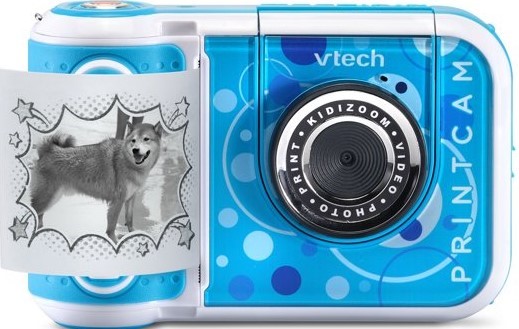
The final gift suggestion from Engadget is the Vtech KidiZoom PrintCam. Admittedly, they’re not as powerful as one of Critical Link’s MityCams, but, hey, it doesn’t have to be powerful. It’s a toy. And it gives kids the old school joy and satisfaction of printing out the pictures they take.

Fun taking this stroll through Technology Toyland, even if it was just window shopping